
Index
Introduction
When decommissioning corporate IT assets, many organizations rely on standard software formatting or basic deletion utilities. However, file deletion and standard reformatting only remove the data pointers, leaving the actual data blocks fully intact and vulnerable to advanced recovery methods. This phenomenon—known as data persistence or data remanence—quietly leaves highly sensitive corporate information exposed on drives thought to be empty.
The risk multiplies drastically when dealing with Hidden Disk Areas, which standard operating systems and standard software-wiping utilities cannot see or access.
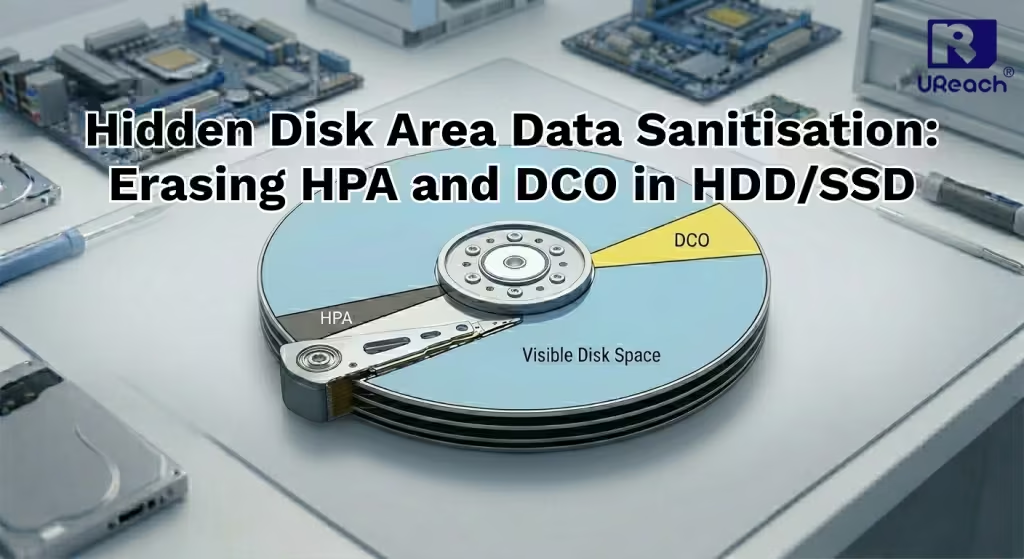
Understanding Hidden Disk Areas: HPA and DCO
Modern hard disk drives (HDDs) and solid-state drives (SSDs) contain hidden sectors designed to partition off space from the end-user. To understand their security risk, it helps to look at how they evolved and how they are used in real-world scenarios:
Host Protected Area (HPA)
Brief History: Introduced in 2001 under the ATA-4 standard, HPA was created as a secure zone on the hard drive that the standard operating system could not alter or accidentally delete.
Real-World Use Cases:
Factory Recovery Partitions: Major PC manufacturers (such as Lenovo, Dell, and HP) use HPA to store the original factory OS recovery image. If a user’s system crashes, a special hotkey at boot unhides this area to reinstall the OS.
Stealth Security & Anti-Theft Software: Security software vendors utilize HPA to store asset-tracking algorithms or root-level anti-theft tools. Because standard operating systems cannot see this area, the software remains intact and operational even if a thief formats the main drive.
Device Configuration Overlay (DCO)
Brief History: Introduced shortly after HPA under the ATA-6 standard to give hardware manufacturers deeper, low-level control over drive architecture.
Real-World Use Cases:
Drive Equalization for Manufacturers: If an enterprise vendor needs a batch of identical 500GB drives for a RAID matrix but only has 600GB units available, they can use DCO to hard-cap the drive size to 500GB. The extra 100GB becomes completely invisible to the user.
Feature Throttling: Manufacturers use DCO to turn off specific hardware capabilities (like S.M.A.R.T. monitoring, NCQ, or high-speed transfer modes) on budget drive models to differentiate them from premium enterprise models, using the exact same physical hardware.
The Risk of Hidden Disk Areas During Erasure
The primary danger of hidden areas during asset disposal is incomplete sanitization.
If an erasure utility does not explicitly issue hardware-level commands to reset the drive configuration, it will only target the visible, user-addressable areas. This creates severe risks:
NIST “Clear” Blind Spot: Standard NIST “Clear” sanitization protocols only wipe user-accessible sectors, meaning hidden partitions like HPA, DCO, and remapped bad sectors remain completely untouched.
Regulatory Non-Compliance: Leaving residual data fragments in non-addressable storage regions violates global privacy mandates, such as GDPR, HIPAA, and CCPA.
Corporate Exposure: Leaving data persistence unaddressed can trigger severe data breaches, resulting in steep financial penalties, regulatory litigation, and catastrophic damage to corporate reputation.
To ensure true compliance and complete security, NIST and IEEE standards explicitly state that any drive configuration blocking access to hidden regions must be reset and fully exposed before a wipe begins.
The Solution: 100% Sanitization with U-Reach Data Erasers
Achieving absolute data finality requires a protocol that forces the drive to uncover its hidden areas. To safely wipe hidden zones, the “Purge” method is universally recommended under both NIST and IEEE guidelines.
U-Reach hardware data erasers are engineered to fully resolve the issue of data persistence across all sectors of a drive:
Forced Area Exposure: U-Reach hardware automatically communicates directly with the drive controller to unhide, unlock, and expose the Host Protected Area (HPA) and Device Configuration Overlay (DCO).
NIST & IEEE Purge Execution: Once exposed, the device leverages rigorous hardware-level Purge protocols—including Sanitize Overwrite, Block Erase, and Enhanced Security Erase—to permanently destroy data blocks across 100% of the drive’s physical storage area.
Forensic Elimination: By filling every hidden and remapped block with zero-fill (0x00) patterns, U-Reach drives data erasure beyond the capabilities of advanced laboratory forensic tools like PC3000 and R-Studio, giving your business complete, audit-ready compliance assurance.
UReach Data Eraser features: Efficiency Without Compromise
Beyond standard visible space, the UReach data eraser is engineered to detect and sanitize every Hidden Disk Area through several key hardware features:
Standalone Security: Operating completely independent of a PC or network, the hardware prevents host operating systems from blocking access to protected zones (like HPA or DCO) while eliminating any risk of network-based data leaks.
Plug-and-Play Simplicity: Despite its ability to automatically unlock and clear hidden sectors, the machine remains incredibly simple—just connect your drives and press start.
Zero Bottlenecks: Unlike software-based utilities that crawl under load, our hardware maintains maximum speed on all ports, ensuring deep sanitization of the entire drive—including non-addressable storage—never slows you down.
One-Time Investment: We offer a license-free, one-time investment for unlimited runs, giving you a highly predictable solution that permanently eliminates data persistence across all visible and hidden partition spaces.

Check out best-selling U-Reach SAS/SATA disks Data Eraser: SAS/SATA SSD/HDD Series Eraser
Check out U-Reach Full Series Eraser: Full Series Data Eraser
Conclusion
Relying on standard software-wiping utilities during hardware decommissioning creates a dangerous corporate blind spot. Because standard tools only sanitize user-addressable sectors, sensitive data hidden within the Host Protected Area (HPA) and Device Configuration Overlay (DCO) remains fully intact. This data persistence directly exposes organizations to regulatory penalties, data breaches, and severe non-compliance under global privacy mandates.
To eliminate this vulnerability and achieve 100% data sanitization, organizations must utilize hardware solutions capable of unhiding and addressing every single sector on the physical storage media. By automatically exposing these hidden disk areas and executing rigorous hardware-level Purge protocols, U-Reach data erasers ensure that corporate data is wiped forever—completely satisfying IEEE 2883 and NIST 800-88 standards while rendering data recovery impossible under forensic deep scans.
With over 20 years of experience, U-Reach Inc. specializes in high-speed, stable data solutions, including duplication, inspection, and data-erasing equipment for Flash, HDD, and M.2 PCI-E SSDs.
U-Reach Malaysia (Fobedo Group Sdn. Bhd.) was established in Kuala Lumpur in 2024 as a local branch, expanding services across South East Asia. U-Reach is a trusted global brand, used by leading companies in industries such as semiconductor IC design, government, military, medical, and data center.
With 8 branches worldwide, U-Reach offers comprehensive technical support and real-time service to meet the needs of local and multinational businesses.
Click here to contact our hard disk cloning professional consultants immediately!

Check out our full series of Cloner: Full Series Data Cloner
Check out Carry series portable cloner: Carry Series HDD/SSD Cloner
UReach-Malaysia official website: https://ureach.com.my/
E-mail: info@ureach.com.my